Pronombres
Personales Pronombres
Acusativos Adjetivos
Posesivos Pronombres
Posesivos Pronombres
Reflexivos I me my mine myself you you your yours yourself he him his his himself she her her hers herself it it its -- itself we us our ours ourselves you you your yours yourselves they them their theirs themselves Pronombres Indefinidos everybody nobody somebody anybody everyone no one someone anyone everything nothing something anything Pronombres Relativos who which that whom whose Pronombres Recíprocos each other / one another
Personales
Acusativos
Posesivos
Posesivos
Reflexivos
Reflexive Pronouns (Pronombres Reflexivos)
Los pronombres reflexivos se usan cuando el sujeto y el complemento de la frase son iguales. Terminan con -self (en singular) y -selves (en plural).
En español se expresa algo parecido con “a mi mismo”, “a si mismo” etc.
myself = a mi mismo
yourself = a ti mismo
himself = a si mismo (él)
herself = a si mismo (ella)
itself = a si mismo (algo sin género)
ourselves = a nosotros mismos
theirselves = a si mismos (ellos, ellas)
Aquí tienes unos ejemplos de frases con los pronombres reflexivos en inglés…
I cut myself while I was cooking.
You’re not acting like yourself. Is everything okay?
He looked at himself in the mirror.
She hurt herself when she was skiing.
The turtle was on its back, trying to turn itself over.
We bought ourselves a new car. Wanna see it?
They locked themselves up in the bedroom and didn’t come out for more than an hour.
El tema de los pronombres reflexivos se complica un poco porque en español se usa mucho el me / te / se etc – que es equivalente – en casos en los que no lo haríamos en inglés.
Me duché. = I took a shower. (No se dice I showered myself.)
Se afeitó el bigote. = He shaved his moustache. (No se dice He shaved himself.)
Unos ejemplos los hemos visto en la sección – con ropa y partes del cuerpo, no se usa el reflexivo sino el adjetivo posesivo: my hair, his eyes, her legs, our teeth, their shoes.
También usamos una expresión con by + un pronombre reflexivo para decir que alguien hace algo solo, sin nadie más.
He lives by himself in a small flat.
She usually has lunch by herself.
You don’t need to help. We can do it by ourselves.
The kids put on their shoes all by themselves. I can’t believe how much they’re growing up!
Y por último, tenemos unas palabras más que también son pronombres…
Lección de inglés: Conócelos y aprende a usarlos
Conocer el idioma inglés es una puerta abierta para la educación, con tan solo entenderle somos capaces de tener acceso a todo tipo de información actualizada y exclusiva, que como se sabrá es mostrada al público primero o exclusivamente en este idioma.
También implica no depender de las traducciones, ya sea por motivos de trabajo, educación y hasta ocio (como ver películas o escuchar canciones). Los pronombres son simples y fáciles de comprender, porque los reflexive pronouns son aquellos que son empleados cuando el sujeto y el complemento del verbo son lo mismo.
Es decir, son usados cuando la acción la ejerce el sujeto del que se habla en la oración. En inglés no se usan tanto los verbos reflexivos como búscame, mejórate, o háblame, sino que se emplean más los siguientes: myself, yourself, himself, herself, itself, ourselves, yourselves y themselves.
Todos ellos se diferencian entre sí gracias a los criterio sintácticos por los cuales se rigen. De esta forma, así se traducirían al español:
• Myself (yo mismo, a mí)
– I painted the car myself (Pinté el carro yo mismo)
– I love myself (Me amo a mí mismo)
– I shave my head myself (Me rasuré la cabeza yo mismo)
• Yourself (tú mismo, a ti)
– You have to believe in yourself (Tienes que creer en ti mismo)
– Do not hit yourself (No te golpees)
– Would you like to understand the problem yourself? (Quisieras tú mismo entender el problema?)
• Himself (él mismo, a sí mismo)
– He cooks everything himself (Él mismo cocino todo)
– He wrote the song himself (Él mismo escribió la canción)
– He himself can do everything (Él mismo podrá con todo)
– That boy threw himself into the pool (Ese niño se arrojó a la pisicna)
• Herself (ella misma, a sí misma)
– She was able to build the building herself (Ella fue capaz de construir el edifcio ella misma)
– She defended herself (Ella se defendió)
– She did it for herself, I’m so proud! (Ella lo hizo por sí misma, estoy tan orgulloso!)
• Itself (él mismo, a sí mismo)
– The dog licked itself, he believes a cat? (El perro se lamió a sí mismo, se cree un gato?)
– The proposal itself surprised everybody in the office (La propuesta misma sorprendió a todos en la oficina)
– The cat threw itself into the water (El gato se arrojó al agua)
• Ourselves (nosotros mismos)
– We agreed ourselves despite the risk (Nos pusimos de acuerdo nosotros mismos a pesar del riesgo)
– We can do great things ourselves if we wish (Nosotros mismos podemos hacer grandes cosas si así lo deseamos)
– Let’s introduce ourselves as we did yesterday (Vamos a presentarnos a nosotros mismos como hicimos ayer)
• Yourselves (ustedes mismos)
– I’m sure they wrote all that yourself (Estoy seguro de que escribieron todo eso ustedes mismos)
– There is no excuse to frighten yourself (No hay excusa para asustarse de ustedes mismos)
– Remember, don’t limit yourselves (Recuerden, no se limiten)
• Themselves (ellos mismos)
– They themselves composed that beautiful song for the competition (Ellos mismos compusieron esa hermosa canción para la competencia)
– They listen to themselves every day (Ellos se escuchan a sí mismos todos los días)
– They themselves were surprised by this result (Ellos mismos se sorprendieron con ese resultado)
Algunas reglas gramaticales
Es importante tener en cuenta algunas normas que nos ayudaran a comprender mejor el uso de los pronombres reflexivos sin necesidad de utilizar y consultar en diccionarios u otras fuentes de información:
1. Los pronombres reflexivos son usados para remarcar al sujeto en la oración, es por esto que es muy común encontrarles es al final de dicha oración.
Por ejemplo:
– I love myself (Me amo a mí mismo)
2. Cuando queremos referirnos a que “solo” una o varias personas hicieron una acción, se usa “by” más el pronombre reflexivo indicado. Así se hace énfasis en que la acción fue realizada sin ayuda y matiza la expresión.
Por ejemplo:
– He learned to speak english all by himself (Él aprendió a hablar ingles solo por sí mismo).
3. Con la mayoría de los pronombre reflexivos se pueden emplear los verbos transitivos (aquellos verbos que exigen la presencia de un objeto directo), pero los más usuales a emplear son: prepare (preparar), blame (culpar), hurt (hacerse daño), cut (cortar), enjoy (disfrutar), help (ayudar).
Por ejemplo:
– I blame herself (La culpo)
4. Hay que recordar que básicamente los pronombres reflexivos están allí para ser el complemento en tres diversos usos. Un pronombre reflexivo puede ser tanto el complemento directo del verbo (cuando sujeto y complemento hablan de lo mismo) como el complemento indirecto, y el complemento de una preposición.
5. Son comunes expresiones que usen los pronombres reflexivos de forma directa.
Por ejemplo:
– Enjoy yourself (Pasatelo bien)
6. Hay una gran diferencia entre los pronombre que terminan en “selves” con respecto a “each other”. Si usa el primero será válido todo lo explicado anteriormente, mientras que si se usa el otro se refiere a “uno al otro”.
Y ahora unos ejercicios
Elige el pronombre correcto
Aprende a elegir el pronombre que concuerde con el sujeto. Rellena los espacios de las frases siguientes con un solo pronombre reflexivo:
- I sometimes ask ____________ why I live in this city.
- They will behave ____________ if they know their parents are watching.
- He is too young to wash ____________.
- I hurt ____________ when I was climbing over a fence.
- You should help ____________ to some salad, it’s excellent!
- Have you seen ____________? You’re a mess!
- This robot can repair ____________.
- You can blame ____________ for what happened.
- Aren’t you enjoying ____________?
- We will have to teach ____________ to play the guitar.
Completa con el pronombre reflexivo correcto.
Ejercicios: Zero conditional
Well, the cooker you the gas on.
Why oil and water you them together?
¿Si pones un huevo en un vaso de agua, flota? you an egg into a glass of water, it ?
Si duermo mal, al día siguiente me enojo con facilidad. I badly, the next day I mad easily.
Ejercicios de primer condicional
Completa las siguientes oraciones con el tiempo verbal correspondiente según sea el caso:
1. If his friends ________ (come), he __________ (be) extremely happy. (Si sus amigos XXX, él XXX extremadamente feliz)
2. If I _________ (save) enough money this year, I ________ (go) to New York. (Si XXX suficiente dinero este año, XXX a Nueva York)
3. You _______ (stay) at my place if you _________ (come) to my city. (XXX quedarte en mi casa si XXX a mi ciudad)
4. His parents _________ (be) upset if he _________ (not/pass) the exam. (Sus padres XXX muy molestos si él XXX el examen)
5. If I________ (pay) today, you _________ (owe) me some money then. (Si XXX hoy, me XXX dinero después)
First conditional. Completa las oraciones siguientes.
Ahora leeremos el texto
Christmas
A Christian holiday signifying the birth of Jesus, Christmas is widely celebrated and enjoyed across the United States and the world. The holiday always falls on 25 December (regardless of the day of the week), and is typically accompanied by decorations, presents, and special meals.
Specifically, the legend behind Christmas (and the one that most children are told) is that Santa Claus, a bearded, hefty, jolly, and red-jacket-wearing old man who lives in the North Pole, spends the year crafting presents with his elves, or small, festive, excited Santa-assistants. All the children who behave throughout the year are admitted to the Good List, and will presumably receive their desired gifts on Christmas, while those who don't behave are placed on the Naughty List, and will presumably (although the matter is determined by parents) receive a lump of coal.
Santa Claus is said to fly around the Christmas sky in a sled powered by his magical reindeer, or cold-resistant, mythically powered, individually named animals, delivering presents to each child's house in the process. Santa is also expected to slide through chimneys to deliver these presents (homes not equipped with chimneys might "leave the front door cracked open"), and children sometimes arrange cookies or other treats on a plate for him to enjoy.
Gifts are placed underneath a Christmas tree, or a pine tree that's decorated with ornaments and/or lights and is symbolic of the holiday. Additionally, smaller gifts may be placed inside a stocking, or a sock-shaped, holiday-specific piece of fabric that's generally hung on the mantle of a fireplace (homes without fireplaces might use the wall). A Christmas tree's ornaments, or hanging, typically spherical decorations, in addition to the mentioned lights, may be accompanied by a star, or a representation of the Star of Jerusalem that the Three Apostles followed while bringing Baby Jesus gifts and honoring him, in the Bible.
Escoge la opción correcta para completar la oración:
If she fixes the TV,
I won’t go to school
If I attend dance class every day,
My best friend will be quite happy
If we meet on Saturday,
If you practice English at least 1 hour a day,
f you don’t do the dishes,
He won’t speak with me ever again
If they do the homework,
I will give you a car
1- If they go to Belgium, they
2-
3- If you go to the party too, we
4- If they don't do well their presentation, they
5- If she
6-
7- If I like the picture, I
8- Will your father come
9- If my sister
10- We
1) If it (will rain/rains) tomorrow, we (will stay/stay) at home.
2) If Mary (will get/gets) to work early, she (will have/has) time to finish the report.
3) Small shops (will close/close) if so many people (will go/go) to hypermarkets.
4) We (will visit/visit) the new museum if it (will not rain/does not rain) .
5) If you (will take/take) the top off, you (will get/get) the water out.
6) If you (will walk/walk) down this street, you (will find/find) the post office.
7) The paella (will not burn/does not burn) if you (will turn down/turn down) the heat.
8) If we (will leave/leave) now, we (will be/are) home in time to see the football match.
9) If Mary (will not like/does not like) the present, John (will buy/buys) something different.
10) My daughter (will finish/finishes) university by 2017 if she (will start/starts) this year.
Condicionales
Los condicionales se emplean para especular acerca de lo que podría ocurrir, lo que puede haber ocurrido y lo que desearíamos que ocurriese. En inglés, la mayoría de las oraciones que emplean el tiempo verbal condicional contienen el término "if". Muchas de las construcciones condicionales del inglés se utilizan en oraciones que incluyen verbos en pasado. Este uso se denomina "el pasado irreal" porque empleamos un tiempo verbal de pasado pero no estamos refiriéndonos a algo que haya sucedido realmente. Hay cinco formas principales de construir oraciones condicionales en inglés. En todos los casos, se componen de una proposición o cláusula con "if" y una proposición principal. En muchas oraciones condicionales negativas existe una construcción alternativa equivalente que usa "unless" en lugar de "if".
| Tipo de oración condicional | Uso | Tiempo verbal de la proposición "if" | Tiempo verbal de la proposición principal |
|---|---|---|---|
| Tipo 0 | Hechos generales | Simple present | Simple present |
| Tipo 1 | Una condición posible y su resultado probable | Simple present | Simple future |
| Tipo 2 | Una condición hipotética y su resultado probable | Simple past | Present conditional o Present continuous conditional |
| Tipo 3 | Una condición no real del pasado y su resultado probable en el pasado | Past perfect | Perfect conditional |
| Mixto | Una condición no real del pasado y su resultado probable en el presente | Past perfect | Present conditional |
Condicional tipo cero
El "zero conditional" se utiliza cuando el tiempo al que nos referimos es ahora o siempre y la situación es real y posible. Este tipo de condicional suele emplearse para hablar de hechos generales. El tiempo verbal de ambas proposiciones es el "simple present". En las oraciones condicionales de tipo 0, el término "if" puede normalmente sustituirse por "when" sin que cambie el significado.
| Proposición "if" | Proposición principal |
|---|---|
| If + simple present | simple present |
| If this thing happens | that thing happens. |
| If you heat ice | it melts. |
| If it rains | the grass gets wet. |
Consulta más información sobre cómo usar el "zero conditional".
Condicional tipo 1
El "type 1 conditional" se emplea para referirse al presente o futuro cuando la situación es real. El condicional tipo 1 se refiere a una condición posible y su resultado probable. En estas oraciones, la cláusula "if" adopta el "simple present" y la proposición principal el "simple future".
| Proposición "if" | Proposición principal |
|---|---|
| If + simple present | simple future |
| If this thing happens | that thing will happen. |
| If you don't hurry | you will miss the train. |
| If it rains today | you will get wet. |
Lección sobre el primer condicional en inglés con explicación / first conditional
Uso
Utilizamos el condicional 1 para hablar de una posibilidad real en el futuro; es decir, de una acción que es posible que ocurra en el futuro siempre y cuando se cumpla la condición.
Ejemplo con explicación:
Pensemos en que una amiga me pidió el favor de ayudarla a estudiar para un examen que se realizará mañana; yo no sé si pueda ayudarla porque no sé si tengo que trabajar mañana, entonces yo le digo:
- If I have time tomorrow, I will help you. (Si tengo tiempo mañana, te ayudaré)

Estructura:
Este condicional tiene dos partes: “la condición” y “el resultado”. Observa los siguientes ejemplos:
+If you come to the party, you will meet my sister. (Si vienes a la fiesta, conocerás a mi hermana)
+If she gets home late, I will be very angry. (Si ella llega a la casa tarde, estaré muy enojado)
La condición:
- If you come to the party, (Si vienes a la fiesta,)
- If she gets home late, (Si ella llega a la casa tarde,)
El tiempo verbal que utilizamos para la oración condicional es el presente simple -“you come” y “she gets”- (Para mayor información sobre este tiempo verbal puedes ir a la lección sobre el presente simple en inglés)
El resultado:
- You will meet my sister. (Conocerás a mi hermana)
- I will be very angry. (Estaré muy enfadado)
Estas frases utilizan el futuro con WILL acompañando de la FORMA BASE DEL VERBO -“will meet” y “will be”-. (Puedes ir a la lección sobre el futuro con WILL)
Básicamente, la estructura es ésta:
If + presente simple, will + infinitive.
Fíjate que al hablar, normalmente usamos las formas cortas de will: I’ll, you’ll, he’ll, she’ll, etc.
If I have time, I’ll call you.
If she has enough money next year, she’ll buy a motorbike.
If I go to Paris, I’ll visit my friend John.
If the weather is good, we’ll go to the beach.
El primer condicional también se puede hacer al revés, con la parte de will al principio:
I’ll visit him if I go to Paris.
I’ll call you if I have time.
She’ll buy a motorbike if she has enough money.
We’ll go to the beach if the weather is good.
Importante: sólo usamos will una vez por frase. En la parte con “if” se entiende que es hipotético y futuro, y así no hace falta repetir el auxiliar “will” en las dos partes.
Negaciones y preguntas en primer condicional
Las negaciones del primer condicional se hacen con will not o bien la forma corta won’t.
If he calls me, I won’t answer.
If I fail the test, I won’t finish university.
If you eat something now, you won’t be hungry later.
También pueden formarse con una negación de la parte con “if”, o con una negación de los dos lados. Depende de lo que quieres decir.
If you don’t eat something now, you’ll be hungry later.
If he doesn’t call, I’ll be very angry!
If you don’t pass the test, you won’t finish university.
If it doesn’t rain, we’ll go for a walk.
Las preguntas en primer condicional se forman como una pregunta normal con will:
What will you do if you fail your test?
Where will you go if you move out of you parents’ house?
What will you say if she asks for your opinion?
Otras expresiones útiles para las frases condicionales
Podemos usar otras palabras en las frases condicionales aparte de if. Por ejemplo: when, as soon as, until. Lógicamente, cambia el significado de la frase.
I’ll call her when I get home.
I’ll tell you as soon as I have the money.
I won’t leave until he arrives.
Aquí tienes otro artículo sobre este tema: Condicionales con when, if y as soon as.
Existe también una condicional con imperativo. Supongo que debería llamarlo un tipo de “condicional mixto.” Pero siendo if + presente simple, podría caer en la definición de primer condicional también.
If you have time, call me.
If you go to the shop, buy some cheese.
If you miss the bus, get a taxi.
1. El zero conditional


2. La estructura del zero conditional
Los condicionales son oraciones compuestas por dos frases. El zero conditional tiene la siguiente estructura:
El orden de las dos frases que componen la estructura del condicional se puede cambiar. Si empezamos por la condición (If), las separaremos con una coma. Si empezamos con la frase que expresa el resultado, no hace falta poner la coma.
3. ¿Cómo se utiliza el zero conditional?
- El zero conditional se utiliza para expresar hechos que siempre son verdaderos como, por ejemplo, hechos científicos, leyes científicas, verdades generales, etc.
 You get orange if you mix red and yellow.Obtienes naranja si mezclas rojo y amarillo.Si mezclas rojo y amarillo, el resultado siempre será el mismo. Por lo tanto, este hecho es una verdad general.
 If I eat peanuts, I get ill.Si como cacahuetes, me pongo enfermo.Aunque enfermarse después de comer cacahuetes no es una verdad universal, para un determinado grupo de personas (alérgicas) es cierto que siempre que los coman provocará este mismo resultado.
 - Además de hechos verdaderos, el zero conditional también se puede utilizar para dar instrucciones. En este caso utilizaremos un imperativo para expresar la instrucción o advertencia.
 If you feel sick, go to the doctor.Si te encuentras mal, ve al médico.
 Don't open the door if someone knocks.No abras la puerta si alguien llama.
| STRUCTURE |
|---|
| IF + PRESENT SIMPLE, + PRESENT SIMPLE |
| USES | EXAMPLES |
|---|---|
| Hechos verdaderos: leyes científicas, verdades generales... | If my dog sees the postman, he barks.Si mi perro ve al cartero, ladra. |
| Dar instrucciones | If it rains, don't go to the playground.Si llueve, no salgáis al patio. |
- If you heat water to 100 degrees, it boils. ...
- If public transport is efficient, people stop using their cars. ...
- If you cross the line, you are in our country. ...
- If children study, then their parents are happy. ...
- Plants die if they don't get enough water.
Ejercicio con condicional cero en inglés
Completa los espacios con el resultado o la condición de las siguienes oraciones.
Pista: en cada una de las oraciones dispones del verbo de la oración.
Recuerda que...
Para hacer el condicional cero en inglés usamos el presente simple tanto para la condición como para el resultado.
1- If you press the switch,
2-
3-
4- If the traffic light is in red,
5- If he has to drive,
6- If I'm on time,
7-
8- If I don't sleep well,
9-
10- She can't work,
Ejercicio con condicional cero en inglés
Completa los espacios con el resultado o la condición de las siguienes oraciones.
Pista: en cada una de las oraciones dispones del verbo de la oración.
Recuerda que...
Para hacer el condicional cero en inglés usamos el presente simple tanto para la condición como para el resultado.
1- If you press the switch,
2-
3-
4- If the traffic light is in red,
5- If he has to drive,
6- If I'm on time,
7-
8- If I don't sleep well,
9-
10- She can't work,
RESPUESTAS
Ejercicio con condicional cero en inglés
Completa los espacios con el resultado o la condición de las siguienes oraciones.
Pista: en cada una de las oraciones dispones del verbo de la oración.
Recuerda que...
Para hacer el condicional cero en inglés usamos el presente simple tanto para la condición como para el resultado.
1- If you press the switch,
2-
3-
4- If the traffic light is in red,
5- If he has to drive,
6- If I'm on time,
7-
8- If I don't sleep well,
9-
10- She can't work,
Completa las siguientes oraciones utilizando el tipo cero de las oraciones condicionales:
1. If you (drop) an egg, it (break).
2. If you (pour) oil on water, it (float).
3. If I (not sleep) well, I (look) like a zombie in the mornings.
4. If you (not buy) Alice everything she wants to, she (cry).
5. If you (pay) with your credit card at Mercadona Supermarkets, you (get) a discount.
1. If you (drop) (drop) an egg, it (breaks) (break).
2. If you (pour) (pour) oil on water, it (floats) (float).
3. If I (don't sleep) (not sleep) well, I (look )(look) like a zombie in the mornings.
4. If you (don't buy) (not buy) Alice everything she wants to, she (cries) (cry).
5. If you (pay) (pay) with your credit card at Mercadona Supermarkets, you (get) (get) a discount.
Elige la respuesta correcta.
A lot of, a lot, lots of explicación
Lección de explicación sobre las diferencias entre a lot of vs. lots of vs. a lot con ejemplos y oraciones
Estas palabras en ocasiones confunden a las personas que están aprendiendo inglés. Así que, por favor, presta mucha atención a la explicación y al finalizar realiza los ejercicios de comprensión.
Antes de comenzar podrías leer la lección sobre la diferencias entre sustantivos contables e incontables en inglés para clarificar un poco los conceptos.
1. Aclaremos primero que tanto la forma “a lot of” como la expresión “lots of” pueden significar algo similar; en realidad, ambas expresiones tienen cinco significados posibles: Muchos, muchas, mucho o mucha, un montón de
Estas palabras en ocasiones confunden a las personas que están aprendiendo inglés. Así que, por favor, presta mucha atención a la explicación y al finalizar realiza los ejercicios de comprensión.
Antes de comenzar podrías leer la lección sobre la diferencias entre sustantivos contables e incontables en inglés para clarificar un poco los conceptos.
1. Aclaremos primero que tanto la forma “a lot of” como la expresión “lots of” pueden significar algo similar; en realidad, ambas expresiones tienen cinco significados posibles: Muchos, muchas, mucho o mucha, un montón de
Se pueden usar con sustantivos contables e incontables. Veamos algunos ejemplos:
a. Contables: muchos, muchas, un montón de
- She has a lot of books / Ella tiene muchos libros
- They needed lots of chairs / Ellos necesitaron muchas sillas
b. Incontables: mucho, mucha, un montón de
- There is a lot of money in my wallet / Hay mucho dinero en mi cartera o billetera
- Did you drink lots of beer last night? / ¿Bebiste mucha cerveza anoche?
Nota:
Estas dos expresiones también pueden ser usadas al principio de la oraciones:
- A lot of people travel alone / Mucha gente viaja sola o Muchas personas viajan solas
- Lots of men cry when they are sick / Muchos hombres lloran cuando están enfermos
2. Ahora vamos a ocuparnos de “a lot”
Usamos esta forma casi siempre al final de una oración y su significado regularmente es “mucho”. Ejemplos:
- I like onions a lot / Me gustan las cebollas mucho
- She visits her family a lot / Ella visita su familia mucho
También es posible usarla con los comparativos con el mismo significado; pero acompañada de un adjetivo. Ejemplos:
- The blue Ipad is a lot cheper than the red one / El Ipad azul es mucho más barato que el rojo
- My flat is a lot bigger than yours / Mi apartamento es mucho más grande que el tuyo
3. Diferencias
Como ya dijimos anteriormente las formas “a lot of” y “lots of” son sinónimos; sin embargo, existe una diferencia grande con la otra expresión.
Si te fijas bien en los ejemplos, podrás darte cuenta que después de “a lot” no usamos un sustantivo (She likes pizza a lot / A ella le gusta la pizza mucho).
Por otro lado, cuando empleamos las palabras “a lot of” y su sinonimo ya mencionado “lots of” sí debemos usar un sustantivo el cual puede ser sustantivo contable –countable noun, por ejemplo “mesas”– o incontable –uncountable noun, por ejemplo “agua”– (She has eaten a lot of pizzas / Ella ha comido muchas pizzas).
Otros cuantificadores
Much / Many / Little / Few / A lot of
1. "much" / "many" / "a lot of" se traducen por "mucho".
Las reglas que se aplican son las siguientes, si bien cabe cierta flexibilidad:
a) En oraciones afirmativas: "a lot of"
b) En oraciones negativas e interrogativas:
b.1) Con sustantivos contables: "many" many books, many coins, many girls...
b.2) Con sustantivos incontables: "much" much time, much effort, much energy...
2. "little" / "few" se traducen por "poco".
a) Con sustantivos contables: "few" few books, few pencils, few tickets...
b) Con sustantivos "incontables": "little" little sugar, little rain, little water...
Ejemplos:
- She is very friendly and has a lot of friends
- I don't have many paintings in my flat
- When you were unemployed, did you receivemuch help from your family?
- This bookshop has few books about Spanish history
- There is little hope that the hostage will be released
1. "much" / "many" / "a lot of" se traducen por "mucho".
Las reglas que se aplican son las siguientes, si bien cabe cierta flexibilidad:
a) En oraciones afirmativas: "a lot of"
b) En oraciones negativas e interrogativas:
b.1) Con sustantivos contables: "many" many books, many coins, many girls...
b.2) Con sustantivos incontables: "much" much time, much effort, much energy...
2. "little" / "few" se traducen por "poco".
a) Con sustantivos contables: "few" few books, few pencils, few tickets...
b) Con sustantivos "incontables": "little" little sugar, little rain, little water...
Ejemplos:
- She is very friendly and has a lot of friends
- I don't have many paintings in my flat
- When you were unemployed, did you receivemuch help from your family?
- This bookshop has few books about Spanish history
- There is little hope that the hostage will be released
Seleccione la palabra más adecuada.
a) I have seen this movie much – many – a lot times.
b) There is not lots – many – much time left.
c) Lots of – Much – Many love to you.
d) I like music very much – lots – a lot of.
e) She has so lots of – many – much friends.
f) I have spent many – a lot – a lot of time thinking about it.
g) How much – many – lots of students are there in this school?
Expresiones con quantifiers
Ya sabes que en este blog nos gusta enseñarte expresiones en inglés. Éstas te harán hablar inglés como si fuera tu lengua materna. En este ejercicio te traemos algunas expresiones que usan much / many / a lot of; ¿sabrás cuál usar en cada caso? Para ayudarte un poco, te hemos incluido la traducción.
I don’t feel up to ____________ today – No tengo ganas de hacer mucho hoy
I’m afraid I’m not _____________ a cook – Me temo que no soy un gran cocinero
There are____ times that I’ve wished I could quit my job – HAy muchas veces en las que desearía poder dejar mi trabajo
There’s an awful ___________ onion in this dish – Hay una cantidad enorme de cebolla en el plato.
Much", "Many", "Little", "Few" - Ejercicios
| 1) | I don't have money. | No tengo mucho dinero |
| 2) | Is there wine in the bottle? | Hay mucho vino en la botella |
| 3) | There is people. | Hay demasiada gente |
| 4) | I don't have questions. | No tengo muchas preguntas |
| 5) | I have trees | Yo tengo unos pocos árboles |
| 6) | Did you buy tequila? | ¿Compraste mucho tequila? |
| 7) | We bought onions. | Compramos pocas cebollas |
| 8) | We drank milk. | Bebimos demasiada leche |
| 9) | I drank water. | Bebí poca agua |
| 10) | There aren't windows. | No hay muchas ventanas |
| 11) | Are there cats inside? | ¿Hay muchos gatos dentro? |
| 12) | I have a friends. | Tengo unos pocos amigos |
| 13) | The lawyer has questions. | El abogado tiene demasiadas preguntas |
| 14) | We have doors at home. | Tenemos pocas puertas en casa |
| 15) | He asked me questions. | Él me preguntó unas pocas cuestiones |
| 16) | Are you drinking tea? | ¿Estás bebiendo mucho té? |
| 17) | We have very money. | Nosotros tenemos muy poco dinero |
| 18) | We bought sugar... | Compramos tanta azúcar |
| 19) | They ate hamburguers. | Ellos comieron demasiadas hamburguesas |
| 20) | No, we didn't break glasses. | No, no rompimos muchos cristales |
https://drive.google.com/file/d/1z260q2fafyz7BqjW1BAJKU5QEgsLCmEL/view?usp=sharing
SEMANA DEL 31 DE AGOSTO AL 4 DE SEPTIEMBRE
Good morning, hoy vamos a ver una lectura en donde repasaremos los modal verbs y el used to
DATE: AUGUST 18, 2020
| can |
| could |
| may |
| might |
| will |
| shall |
| should |
| ought to |
| must/have to |
| would |
Uses (Usos)
Can
| I can speak five languages.(Puedo hablar cinco idiomas.) |
| We can work late tonight if you need us.(Podemos trabajar hasta tarde esta noche si nos necesitas.) |
| Bill and Tom can’t help you.(Bill y Tom no pueden ayudarte.) |
| The restaurant can be expensive if you drink a lot of wine.(El restaurante puede ser caro si bebes mucho vino.) |
| It can be dangerous to drive if you are tired.(Conducir puede ser peligroso si estás cansado.) |
| Can I have a glass of water?(¿Puedo tomar un vaso de agua?) |
| Can you help me?(¿Puedes ayudarme?) |
| Can they work late tonight?(¿Pueden trabajar hasta tarde esta noche?) |
Could
| Joe could speak Spanish when he was young.(Joe podía hablar español cuando era joven.) |
| I couldn’t sleep last night.(No pude dormir anoche.) |
| Could you play an instrument when you were a child?(¿Podías tocar un instrumento cuando eras un niño?) |
| You could pass the test if you studied.(Podrías pasar el examen si estudiaras.) |
| I think it could rain later.(Creo que podría llover más tarde.) |
| Could you pass the salt please?(¿Podría pasarme la sal por favor?) |
| Could you help me?(¿Podrías ayudarme?) |
| Could I be wrong?(¿Podría estar equivocado?) |
May
| I would bring an umbrella, it may rain later.(Llevaría un paraguas, puede llover más tarde.) |
| It may be better to finish this now, rather than wait until tomorrow.(Tal vez sea mejor terminar esto ahora, en lugar de esperar hasta mañana.) |
| You may leave if you like.(Puede salir si quiere.) |
| You may use your cell phones now.(Pueden usar sus teléfonos ahora.) |
| May I have a glass of water?(¿Podría tomar un vaso de agua?) |
| May I leave now?(¿Podría salir ahora?) |
Might
| I would bring an umbrella, it might rain later.(Yo llevaría un paraguas, puede llover más tarde.) |
| It might be better to finish this now, rather than wait until tomorrow.(Tal vez sea mejor terminar esto ahora, en lugar de esperar hasta mañana.) |
Will
| I will help you.(Te ayudaré.) |
| We will learn English.(Aprenderemos inglés.) |
| Will they find a cure for cancer?(¿Encontrarán una cura para el cáncer?) |
| Will you help me move?(¿Me ayudas a mudarme?) |
| Will he go to Paris by car or train?(¿Irá a París en coche o en tren?) |
Shall
| Chris shall be happy to see you.(Chris estará feliz de verte.) |
| I’ll take the 3 o’clock train.(Tomaré el tren a las 15h.) |
| Shall we meet at 10pm?(¿Quedamos a las 22h?) |
| Shall we go to the movies or a museum?(¿Vamos al cine o a un museo?) |
Should
| I should call my parents more often.(Debería llamar a mis padres más a menudo.) |
| You shouldn’t work so hard.(No debería trabajar tan duro.) |
| They should practice more if they want to win the championship.(Deberían practicar más si quieren ganar el campeonato.) |
| Should we leave a tip?(¿Deberíamos dejar una propina?) |
| Should I have the steak or the chicken?(¿Debería comer el bistec o el pollo?) |
| Where should they meet you?(¿Dónde deberían encontrarte?) |
Ought to
| She ought to quit smoking.(Debería dejar de fumar.) |
| I ought to call my parents more often.(Debería llamar a mis padres más a menudo.) |
| They ought to work less.(Deberían trabajar menos.) |
Must
| You must [have to] read this book, it’s fantastic.(Tienes que leer este libro, es fantástico.) |
| You must [have to] brush your teeth two times a day.(Tienes que cepillarte los dientes dos veces al día.) |
| We must [have to] leave now or we will be late.(Tenemos que irnos ahora o llegaremos tarde.) |
| You must not drink and drive.(No puedes beber y conducir.) |
| When must we meet you?(¿Cuándo debemos quedar? ) |
| John’s not here. He must be sick because he never misses class.(John no esta aquí. Debe estar enfermo porque nunca pierde clases.) |
| It must be difficult to learn a new language as an adult.(Debe ser difícil aprender un idioma como adulto.) |
| Must you always be late?(¿Siempre tienes que llegar tarde?) |
| Must she talk so much?(¿Tiene que hablar tanto?) |
Would
| She would like to go to New York someday.(Le gustaría ir a Nueva York algún día.) |
| I would like a beer and my wife would like a glass of wine please.(Me gustaría una cerveza y a mi mujer le gustaría una copa de vino por favor.) |
| Would you like some coffee?(¿Le gustaría un cafe?) |
| Would you help me please?(¿Me ayudas por favor?) |
| When would you like to go to the movies?(¿Cuándo te gustaría ir al cine?) |
- Vámonos
- Hagámoslo
- Vamos al cine
- Almorcemos mañana
- Let’s go: vámonos
- Let’s do it: hagámoslo
- Let’s go to the movies: Vamos al cine
- Let’s have lunch tomorrow: almorcemos mañana
- Let’s not buy that house: no compremos esa casa
- Let’s not behave like that: no nos comportemos así
- Let’s not be sad: no estemos tristes
¡Salgamos!
¡Hagámoslo!
¡Comamos!
¡Llamémoslo!
LA LÓGICA DE LET’S EN INGLÉS
EL VERBO “TO BE”
¡Estemos listos a tiempo!
¡Seamos positivos!
¡No nos quedemos aquí!
¡No esperemos aquí!
¡No nos despertemos demasiado temprano!
¡No seamos tontos!
- ¿Qué tal si…?
- ¿Qué te parece…?
- How about going to the movies? ¿Qué te parece si vamos al cine?
- How about having dinner together? ¿Qué tal si cenamos juntos?
- How about buying some wine for the party? ¿Qué te parece si compremos vino para la fiesta?
Cómo utilizar "shall" y "let´s"
La teoría
- Cuando nos ofrecemos para hacer algo, decimos Shall + I + verbo + ? (¿Lo hago?)
- Cuando le proponemos a alguien hacer algo juntos, decimos Shall + we + verbo + ? (¿Lo hacemos?)
- Sólo usamos shall en la primera persona, I y we.
- Otra forma de proponer algo de manera informal es con Let’s + verbo (Hagámoslo).
- Shall I go? (¿Me voy?)
- Shall we go? (¿Nos vamos?)
- Let’s eat now! (¡Comamos ahora!)
- Let’s not eat now. (No comamos ahora.)
La práctica
¿Llamo yo y hago la reserva?
|
Shall I call and make the reservation?
|
¿Conduzco yo esta noche?
|
Shall I drive tonight?
|
¿Abro la ventana?
|
Shall I open the window?
|
¿Salimos esta noche?
|
Shall we go out tonight?
|
¿Cenamos pescado?
|
Shall we have fish for dinner?
|
¿Les ofrecemos pagar por adelantado?
|
Shall we offer to pay them in advance?
|
Cenemos con ellos mañana.
|
Let’s have dinner with them tomorrow.
|
No vayamos a París, vayamos a Londres.
|
Let’s not go to Paris, let’s go to London.
|
Démosles un poco más de tiempo
|
Let’s give them a little more time
|
Ejercicios
!
?
!
?
Algunos de los más comunes son:
Back: atrás, detrás
In front of: en frente de
Here: aquí, acá
Upstairs: en el piso de arriba
Inside: adentro
Ahead: adelante
Aside: a un lado, aparte
There: allí, allá
Downstairs: en el piso de abajo
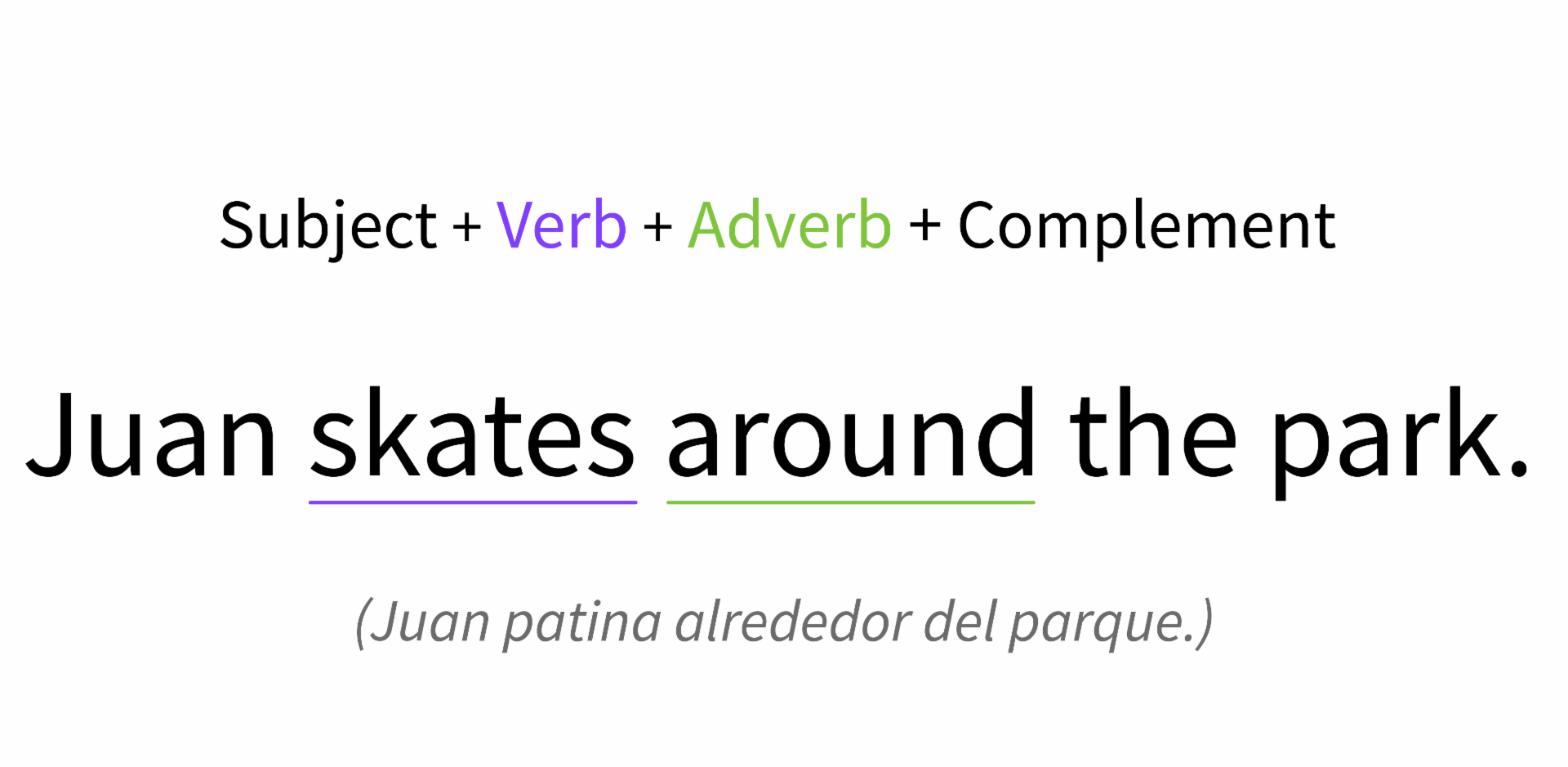
- here (jíer) - aquí
- there (déer) - allá
- near (níar) -cerca.
- nearby (níirbai) -cerca.
- far (fár) - lejos.
- away (euéi) – lejos.
ABOVE – ARRIBA
|
FOREWARD – HACIA DELANTE
|
ABROAD – EN EL EXTRANJERO
|
HERE – AQUÍ
|
AHEAD – DELANTE, AL FRENTE
|
IN – DENTRO
|
ANYWHERE – EN CUALQUIER PARTE
|
INDOORS – DENTRO (DE CASA)
|
AROUND – ALREDEDOR
|
INSIDE – DENTRO
|
AWAY – LEJOS
|
INWARDS – HACIA ADENTRO
|
BACK – DE REGRESO
|
NEAR – CERCA
|
BACKWARD(S) – HACIA ATRÁS
|
NOWHERE – EN NINGUNA PARTE
|
BEHIND – DETRÁS
|
OFF – LEJOS, FUERA
|
BELOW – DEBAJO
|
OUT – FUERA
|
DOWN – ABAJO
|
OUTSIDE – FUERA
|
DOWNSTAIRS – ABAJO (PISO)
|
OUTWARDS – HACIA FUERA
|
DOWNWARDS – HACIA ABAJO
|
SOMEWHERE – EN ALGUNA PARTE
|
EVERYWHERE – EN TODAS PARTES
|
THERE – ALLÍ
|
FAR - LEJOS
|
UP - ARRIBA
|
UPSTAIRS – ARRIBA (PISO)
| |
UPWARDS – HACIA ARRIBA
|
Ejemplos:
- She was hidden behind the door - Ella estaba escondida detrás de la puerta.
- In winter the temperature is below 0º - En invierno, la temperatura es bajo cero.
- He was waiting downstairs - Él estaba esperando abajo.
- The car is parked outside - El coche está aparcado fuera.
Ejemplos:
- They are in France for holidays - Están en Francia por vacaciones.
- We came from Sweden - Venimos de Suecia.
| Preposición | Traducción |
|---|---|
| About | Rodeada |
| Above | Por encima de/ arriba |
| Abroad | En el extranjero |
| Anywhere | Cualquier lugar |
| Away | Fuera |
| Back | De vuelta |
| Backwards | Hacia atrás |
| Behind | Detrás |
| Below | Debajo |
| Between | En medio |
| Down | Abajo |
| East | Hacia el este. |
| Elsewhere | En otro lugar |
| Far | Lejos |
| Here | Aquí |
| In | Dentro |
| In front of | Delante |
| Inside | Adentro |
| Near | Cerca |
| Next to | Al lado |
| Off | Lejos (en el futuro) |
| On | Encima |
| Out | Fuera |
| Outside | Afuera |
| Over | Por encima |
| There | Aquí |
| Under | Debajo |
| Up | Arriba |
Trabaja en los adverbios de lugar en inglés
used to
Como estudiamos en la lección 2 de nivel avanzado, se puede usar "used to" para acciones habituales del pasado.I used to walk to school.
Caminaba a la escuela.
I didn't use to walk to school.
Did you use to walk to school?
be used to
I am used to exercising every day.
Estoy acostumbrado a hacer ejercicio todos los días.
get used to
I am getting used to waking up early.
Me estoy acostumbrando a levantarme temprano.
I used to walk.
I am used to walking.
I get used to walking.
Selecciona la traducción correcta de las oraciones.
Escribe la oración en inglés traduciéndola del español. Usa la información en el parentesis en la traducción.
Me acostumbré a hablar inglés.
Por ejemplo - I'm used to swimming.
DATE: JULY 28, 2020
El futuro con will y going to
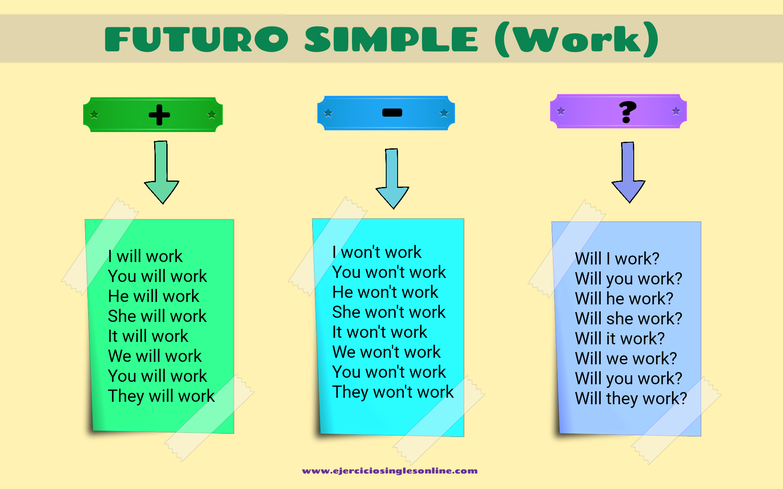
- «Will»: I will finish this at some point.
- «Going to»: I am going to make dinner for them.
- Presente continuo: I am travelling to India for a meeting tomorrow.
- Presente simple: Classes start at 8:00.
- Predicciones o sucesos que creemos que pasarán.
- Decisiones que tomamos sobre la marcha.
- Acontecimientos que sabemos con certeza que se producirán.
¿Cuándo usar «Will» y «going to»?
Voy a morir algún día.
|
I’m going to die one day.
|
Esta noche voy a ver una película.
|
I’m going to watch a film tonight
|
La teoría
Voy a decir adiós.
|
I’m going to say goodbye.
|
(Él) Va a contar una historia.
|
He’s going to tell a story.
|
No voy a coger el teléfono.
|
I’m not going to pick up the phone.
|
No vamos a coger ese vuelo.
|
We aren’t going to catch that flight.
|
¿Vas a beberte la leche?
|
Are you going to drink your milk?
|
¿Va a sentarse aquí? (Ud.)
|
Are you going to sit here?
|
La práctica
Voy a empezar yoga la semana que viene.
|
I’m going to start yoga classes next week.
|
Voy a ir al médico mañana.
|
I’m going to see a doctor tomorrow.
|
Voy a contarte una historia esta noche.
|
I’m going to tell you a story tonight.
|
No voy a ganar este año.
|
I’m not going to win this year.
|
No voy a ir a la fiesta.
|
I’m not going to go to the party.
|
No voy a coger ese avión.
|
I’m not going to catch that plane.
|
¿Vas a llamarle (a él) esta tarde?
|
Are you going to call him this afternoon?
|
¿Vas a ver el partido?
|
Are you going to watch the game?
|
¿Vas a decirle (a ella) lo que piensas?
|
Are you going to tell her what you think?
|
Ejercicios will y going to
- I think we should stay at home. Look at those clouds, it ___________________ (rain).
- Can’t you open the jar? Don’t worry, I ___________________ (open) it for you.
- I ___________________ (take) my children to the theme park soon.
- We ___________________ (not be) in time for the show if we don’t hurry! It’s almost eight now!
- There seems to be a traffic jam further up that road, se we _________________ (take) the other one.
- The cat has been acting weird for a few days so I ___________________ (take) it to the vet.
- She has bought some comic books for my brother. I’m sure he ______________ (like) them.
- I ______________________ (not clean) up your mess again.
- Watch out! You ___________________ (fall) into that hole.
- This year I ___________________ (win) the lottery for sure, I have a hunch.
Respuestas
- I think we should stay at home. Look at those clouds, it is going to rain.
- You can’t open the jar? Don’t worry, I’ll open it for you.
- I’m going to take / will take my children to the theme park soon.
- We won’t be in time for the show if we don’t hurry! It’s almost eight now!
- There seems to be a traffic jam further up that road, so we‘ll take / are going to take the other one.
- The cat has been acting weird for a few days so I‘m going to take it to the vet.
- She has bought some comic books for my brother. I’m sure he’ll like them.
- I‘m not going to clean / won’t clean up your mess again.
- Watch out! You’re going to fall /’ll fall into that hole.
- This year I’ll win the lottery for sure, I have a hunch.
WILL VS GOING TO - EXERCISE 3
Will or going to se refieren a hechos futuros pero se usan en contextos diferentes. Mientras que will se usa para prometer cosas y hablar de decisiones espontáneas, going to es más común para hablar de hacer planes o intenciones.
Futuro en inglés: will or going to?
o- Will or going to expresan futuro.
- Will se usa para algo que acabamos de decidir.
- Going to se usa para hacer planes.
Will or going to? ¿Cuáles son las diferencias?
- He is going to come home tomorrow, we talked last Monday about this.
- He is bored now. He will come back home.
- He is going to come home tomorrow, we talked last Monday about this. – Él va a venir a casa mañana. Hablamos el pasado lunes sobre eso.
- He is bored now. He will come back home. – Él está aburrido ahora. Volverá a casa.
Will, las decisiones y las promesas: I will always love you!
- No way! I’ll pay for this lunch! I owe you! – ¡De ninguna manera! ¡Pago yo este almuerzo! ¡Te lo debo!
- I promise I will always love you. – Te prometo que siempre te amaré
- I promise I won’t be late again. – Os prometo que no llegaré tarde de nuevo.
What are you going to do this weekend?
- What are you going to do this weekend? – ¿Qué vas a hacer este fin de semana?
- I’m going to go to the cinema. – Voy a ir al cine.
What or going to: predictions
- Is it going to rain on Saturday or do you think it will be a sunny day? – ¿Va a llover este sábado o crees que será un día soleado?
Los verbos will or going to y sus formas
- Will se contrae normalmente con el pronombre:
I’ll do it for you
She’ll pay the bill
He’ll come home in an hour
I promise we’ll do the washing up later - Going to se forma con el verbo to be y también tiene forma contracta gonna, en este caso más informal que la forma plena going to:
I’m gonna go to the beach
You’re gonna study abroad next year
FUTURO SIMPLE (WILL)
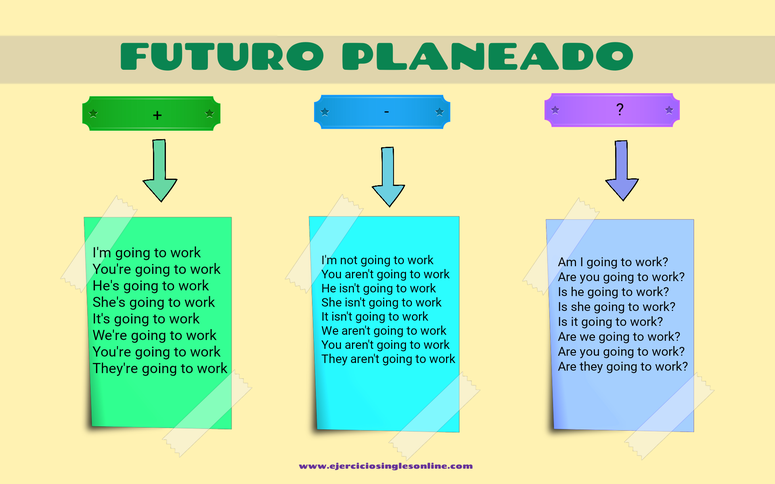
FUTURO PLANEADO (GOING TO)
- Se trata de un futuro planeado porque decimos cuando se va a ejecutar la acción. Por ejemplo: I am going to go to David’s party this weekend.
- Afirmativa: sujeto + am/is/are + going to + infinitivo + complementos
Ejemplo: She is going to visit her aunt on Saturday
- Negativa: sujeto + am/is/are + not + going to + infinitivo + complementos
Ejemplo: She isn't going to visit her aunt on Saturday
- Interrogativa: am/is/are + sujeto + going to + complementos?
Ejemplo: Is she going to visit her aunt on Saturday?

No hay comentarios.:
Publicar un comentario