Elige la respuesta correcta.
2. ______ are the cakes my wife prepared for the party, they taste really good! Do you see them on the table?
- These
- Those
- This
- That
3. My best friend gave me ______ books for my birthday. I have not read them yet, but they seem interesting.
- This
- That
- These
- Those
4. ______ car was my brother’s car. He bought a new one, so my dad gave it to me for my graduation.
- This
- That
- These
- Those
5. That computer, the black _____ next to the keyboard, is the computer that I want to buy.
- One
- Ones
6. My mom bought those earphones, the _____ that girl is looking.
- One
- Ones
Ejercicios
Elige el determinante o pronombre demostrativo correcto.
Elige el demostrativo correcto.
Ejercicios Present Simple. Afirmativo, negativo e interrogativo.
Antonio______(work) in a school.
____you_____ (like) pizza?
She _______ (not/learn) English.
We_____(study) Maths.
You _____(use) a dictionary
Martha never _______ (watch) television.
He always_____(play) football with us.
She ____ up very early.
He ____ Mary every Mondays
John never ____ fresh fish.
He often ____ swimming on Thursdays.
_______ he _______ (want) to eat?
John_______ (study) English at university.
She _______ (not/speak) French.
I _______ (not/do) my homework.
I sometimes__________(go) to work by car.
John_________(work) in a hospital.
She _______ (not/teach) French.
Harry always _______ (watch) television.
Martin and I _______ (not/live) in a big house.
Julia _______ (study) English at university.
_______ he _______ (want) to play?
They always _______ (eat) dinner at 8 o'clock.
Ejercicios Present Simple. Afirmativo, negativo e interrogativo.
Antonio______(work) in a school.
____you_____ (like) pizza?
She _______ (not/learn) English.
We_____(study) Maths.
You _____(use) a dictionary
Martha never _______ (watch) television.
He always_____(play) football with us.
She ____ up very early.
He ____ Mary every Mondays
John never ____ fresh fish.
He often ____ swimming on Thursdays.
_______ he _______ (want) to eat?
John_______ (study) English at university.
She _______ (not/speak) French.
I _______ (not/do) my homework.
I sometimes__________(go) to work by car.
John_________(work) in a hospital.
She _______ (not/teach) French.
Harry always _______ (watch) television.
Martin and I _______ (not/live) in a big house.
Julia _______ (study) English at university.
_______ he _______ (want) to play?
They always _______ (eat) dinner at 8 o'clock.
Ejercicios: Presente Simple – Interrogativo y Negativo
En esta oportunidad te proponemos realizar el siguiente ejercicio reescribiendo las oraciones en la forma interrogativa y negativa del Presente Simple, por ejemplo:
Does the Earth move around the Sun?
The Earth doesn’t move around the Sun.

|

Completa las oraciones con “do” o “does”
1.
- she play soccer?
2.
- you like listening to music?
3.
- you watch TV at night? Yes, I .
4.
- Laura work on Saturdays? Yes, she .
5.
- the cat drink milk? Yes, it .
6.
- the cats drink milk? Yes, they .
7.
- Maria and Laura listen to music at home?
8.
- the computer work fine? Yes, it .
Elige la forma correcta de do/does, como auxiliar y como verbo principal de la oración, según corresponda.
Turn the following sentences into negative and interrogative using present simple tense:
1. She (send) many messages with her mobile everyday. (Affirmative)
.(Negative)
? (Question)
2. I (go) shopping on Mondays. (Affirmative)
. (Negative)
? (Question)
3. She (like) wearing sunglasses. (Affirmative)
. (Negative)
? (Question)
Ejercicios del presente simple afirmativo II
Presente simple afirmativo. Escribe el verbo en verde en presente simple.
1 John (to be)
2 I (to earn)
3 She (to come)
4 Peter (to know)
6 Mary (to eat)
7 My father (to have)
8 My son usually (to play)
10 They (to buy)
Do - Does
El verbo to do en español se traduce como hacer. Dependiendo del pronombre con que se conjugue, este verbo cambia. Si se conjuga con I, you, we y they, simplemente es do. Pero si se conjuga con he, she e it, pronombres en tercera persona singular, se escribe does, así:
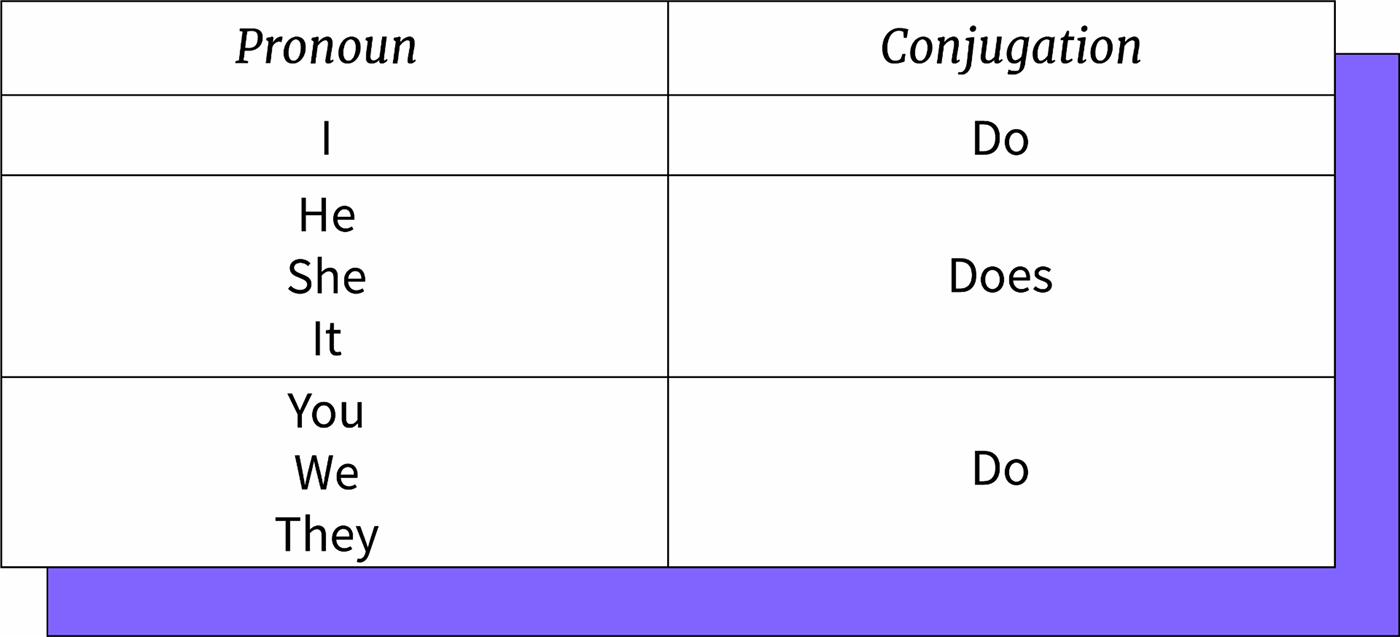
Por ejemplo:
|
|
La forma en tiempo pasado de do es did, y su pasado participio es done.
Como verbo auxiliar
Este verbo también cumple funciones de verbo auxiliar para crear preguntas y para negar algo en presente y en pasado simple. Veamos:
Preguntas:
El verbo to do o does se usa como auxiliar para hacer preguntas con verbos en presente y pasado simple, excepto si en la oración también está presente el verbo to be. Cuando do funciona como auxiliar interrogativo, va al inicio de la oración o entre la Wh Question y el sujeto de la oración.
Ejercicios DO y DOES
En este test vamos a trabajar, no solo el DO y el DOES, sino que vamos a añadir también su forma del pasado: el DID. Conocer bien los tres es imprescindible para hacer preguntas, ya que TO DO, a parte de ser un verbo, también es un auxiliar de otros verbos. Así pues, en los ejercicios que tienes justo a continuación vas a poder comprobar tu dominio de estas partículas en inglés.
____ she want to come? (¿Quiere venir ella?)
He ____ play tennis (Él no juega a tenis)
I ____ love you! (¡Yo sí te quiero!)
____ you want to go to London? (¿No quieres ir a Londres?)
They ____ like pineapple (A ellos sí les gusta la piña)
Why ____ we fight for this? (¿Por qué luchamos por esto?)
____ she like pears? Yes, she ____ (Le gustan las peras? Sí, le gustan)
Anne speaks French, ____ she? (Anne habla francés, ¿no?)
You never cry, ____ you? (Tú nunca lloras, ¿verdad?)
It ____ hurt! (¡Sí que duele!)
A lot of, a lot, lots of explicación
Lección de explicación sobre las diferencias entre a lot of vs. lots of vs. a lot con ejemplos y oraciones
Estas palabras en ocasiones confunden a las personas que están aprendiendo inglés. Así que, por favor, presta mucha atención a la explicación y al finalizar realiza los ejercicios de comprensión.
Antes de comenzar podrías leer la lección sobre la diferencias entre sustantivos contables e incontables en inglés para clarificar un poco los conceptos.
1. Aclaremos primero que tanto la forma “a lot of” como la expresión “lots of” pueden significar algo similar; en realidad, ambas expresiones tienen cinco significados posibles: Muchos, muchas, mucho o mucha, un montón de
Estas palabras en ocasiones confunden a las personas que están aprendiendo inglés. Así que, por favor, presta mucha atención a la explicación y al finalizar realiza los ejercicios de comprensión.
Antes de comenzar podrías leer la lección sobre la diferencias entre sustantivos contables e incontables en inglés para clarificar un poco los conceptos.
1. Aclaremos primero que tanto la forma “a lot of” como la expresión “lots of” pueden significar algo similar; en realidad, ambas expresiones tienen cinco significados posibles: Muchos, muchas, mucho o mucha, un montón de
Se pueden usar con sustantivos contables e incontables. Veamos algunos ejemplos:
a. Contables: muchos, muchas, un montón de
- She has a lot of books / Ella tiene muchos libros
- They needed lots of chairs / Ellos necesitaron muchas sillas
b. Incontables: mucho, mucha, un montón de
- There is a lot of money in my wallet / Hay mucho dinero en mi cartera o billetera
- Did you drink lots of beer last night? / ¿Bebiste mucha cerveza anoche?
Nota:
Estas dos expresiones también pueden ser usadas al principio de la oraciones:
- A lot of people travel alone / Mucha gente viaja sola o Muchas personas viajan solas
- Lots of men cry when they are sick / Muchos hombres lloran cuando están enfermos
2. Ahora vamos a ocuparnos de “a lot”
Usamos esta forma casi siempre al final de una oración y su significado regularmente es “mucho”. Ejemplos:
- I like onions a lot / Me gustan las cebollas mucho
- She visits her family a lot / Ella visita su familia mucho
También es posible usarla con los comparativos con el mismo significado; pero acompañada de un adjetivo. Ejemplos:
- The blue Ipad is a lot cheper than the red one / El Ipad azul es mucho más barato que el rojo
- My flat is a lot bigger than yours / Mi apartamento es mucho más grande que el tuyo
3. Diferencias
Como ya dijimos anteriormente las formas “a lot of” y “lots of” son sinónimos; sin embargo, existe una diferencia grande con la otra expresión.
Si te fijas bien en los ejemplos, podrás darte cuenta que después de “a lot” no usamos un sustantivo (She likes pizza a lot / A ella le gusta la pizza mucho).
Por otro lado, cuando empleamos las palabras “a lot of” y su sinonimo ya mencionado “lots of” sí debemos usar un sustantivo el cual puede ser sustantivo contable –countable noun, por ejemplo “mesas”– o incontable –uncountable noun, por ejemplo “agua”– (She has eaten a lot of pizzas / Ella ha comido muchas pizzas).
MUCH MANY y A LOT OF en inglés: Explicación con usos, ejercicios y pronunciación
Estas palabras, Much Many y A lot of en inglés, se usan para a hablar de cantidades indeterminadas. En la siguiente explicación abordaremos su pronunciación, sus usos y un ejercicio de comprensión final. Comencemos:
¿Cómo se usa A lot Of?
A lot of sólo se usa en oraciones afirmativas. Puede tener 4 significados en español: muchos, muchas, mucho y mucha:
- She has a lot of pencils in her backpack / Ella tiene muchos lápices en su mochila
- We have a lot of beds in our house / Tenemos muchas camas en nuestra casa
- Daryl has a lot of free time / Daryl tiene mucho tiempo libre
- I buy a lot of water because I work out every day / Compro mucha agua porque hago ejercicio todos los días
Explicación sobre Much?
Much se usa con sustantivos incontables (también conocidos como No Contables, ya que no se pueden). Se utiliza con oraciones negativas e interrogativas. Tiene dos significados: Mucha y Mucho.
Ejemplos en oraciones negativas:
- She doesn’t have much time because she has 3 children / Ella no tiene mucho tiempo porque tiene 3 hijos
- They haven’t had much work at the office since October / No han tenido mucho trabajo en la oficina desde octubre
- I won’t need much water for the training / No necesitaré mucha agua para el entrenamiento
Ejemplos en oraciones interrogativas:
- Will you bring much water tomorrow? / ¿Traerás mucha agua mañana?
- Does he have much paperwork to do? / ¿Tiene mucho papeleo que hacer?
–> Resultaría útil que supieras la diferencia entre los sustantivos contables e incontables en inglés
–> Estudia cómo usar el verbo Take
¿Cuál es la definición y el uso de Many?
Many se emplea con sustantivos contables (aquellos que pueden ser contados como por ejemplo las manzanas, los libros, las camas, entro otras). Se emplea en frases en negativo o interrogativo. Su significado es: Muchos y Muchas.
Interrogativo:
- Is he going to need many balloons for the party? / ¿Va a necesitar muchos globos para la fiesta?
- Have you stayed at many 5-star hotels? / ¿Te has hospedado en muchos hoteles de 5 estrellas?
- Are there many beds at the beach house? / ¿Hay muchas camas en la casa de la playa?
Negativo:
- I am not going to need many chairs for the meeting / No voy a necesitar muchas sillas para la reunión
- There aren’t many bulbs in my house / No hay muchos focos en mi casa
1) Seleccione la palabra más adecuada.
a) I have seen this movie much – many – a lot times.
b) There is not lots – many – much time left.
c) Lots of – Much – Many love to you.
d) I like music very much – lots – a lot of.
e) She has so lots of – many – much friends.
f) I have spent many – a lot – a lot of time thinking about it.
g) How much – many – lots of students are there in this school?
Expresiones con quantifiers
Ya sabes que en este blog nos gusta enseñarte expresiones en inglés. Éstas te harán hablar inglés como si fuera tu lengua materna. En este ejercicio te traemos algunas expresiones que usan much / many / a lot of; ¿sabrás cuál usar en cada caso? Para ayudarte un poco, te hemos incluido la traducción.
I don’t feel up to ____________ today – No tengo ganas de hacer mucho hoy
I’m afraid I’m not _____________ a cook – Me temo que no soy un gran cocinero
There are____ times that I’ve wished I could quit my job – HAy muchas veces en las que desearía poder dejar mi trabajo
There’s an awful ___________ onion in this dish – Hay una cantidad enorme de cebolla en el plato.
THERE IS Y THERE ARE ( DEL VERBO HABER)
| Ejemplos de nombres incontables | |
Bread Butter Coffee Money Love water Milk Work Soap Sugar Wood Time Meat Salt Paper Rice Honey Cheese | Pan Mantequilla Café Dinero Amor Agua Leche Trabajo Jabón Azúcar Madera Tiempo Carne Sal Papel Arroz Miel Queso |
Let's practice
Presente simple 'There is' y 'there are'
There are some books on the chair.
https://drive.google.com/file/d/1o7-BiB_CKZj3Y9lxxqCgPUH18NSrI8gx/view?usp=sharing
...
Form (Forma)
Ejercicios con el verbo to be en inglés
- Jim ________ eating ice cream.
- The kids ________ playing in the park.
- Birds ________ singing.
- Henry and I ________ watching football.
- Bees ________ gathering honey.
- Tom and Karen ________ skiing.
- Sam ________ washing her hands.
- Tim ________ crying.
- They ________ rowing the boat.
- I ________ drinking wine.
- The birds ________ flying south.
- They ______ loving parents.
- I ________ dancing.
- Sarah and Thomas ________ getting married.
- I ________ beginning to understand English.
- The house ________ burning down.
- The fruit ________ hanging low on the tree.
- The baby ________ waking up.
- I ________ crawling.
- There ________ a meaning to every poem.
Ejercicios con Presente Continuo: afirmaciones
- Tina ___________ ___________ water. (drink)
- They ___________ __________ to France. (travel)
- Fred ___________ ___________ a pie. (eat)
- The weather ___________ always ______. (change)
- She ___________ ___________ pasta. (cook)
- It ___________ __________ outside. (rain)
- The lady ___________ __________ for the bus. (wait)
- I ___________ __________ my aunt. (visit)
- It ___________ ___________ cold outside. (freeze).
- Jack and Jill ___________ _________ up the hill. (climb)
- Mom ___________ ___________ out to buy some groceries. (go)
- The little girl ___________ ___________ the newspaper. (tear)
- Nadal ___________ ___________ the match. (win)
- Janet ___________ ___________ tea. (have)
- The thief ___________ ___________ behind the bushes. (hide)
- The sun ___________ ___________ brightly. (shine)
- The birds ___________ ___________. (fly)
- Gina’s son ___________ ___________ his cat with a blanket. (cover)
- I ___________ ___________ a letter. (write)
- I ___________ __________ some eggs to make an omelette. (bea

– Over here. (Aquí.)
– There. (Ahí/Allí/Allá.)
– Over there. (Allí/Allá.)
-John spilled the wine everywhere (John derramó el vino por todas partes).
-She went downstairs (Bajó).
- What's it doing over there? (¿Qué hace ahí?).
- You left it here last night' (Te lo dejaste aquí anoche).
SEMANA DEL 27 AL 31 DE JULIO
DATE: JULY 27, 2020
Adjetivos demostrativos
Exercises
____'s nice! (¡Eso es bonito!).
____ shoes are very expensive (Estos zapatos son muy caros).
I'm in love with ____ boy (Estoy enamorada de este chico).
Who's ____ woman? (¿Quién es esa mujer?).
Hi! ____ is John (¡Hola! Soy John).
____ boys are very rude (Esos chicos son muy maleducados).
I love ____ kind of food (Me encanta este tipo de comida).
Well, he told me ____ (Bueno, él me dijo eso).
____ are my new friends (Estos son mis nuevos amigos).
____'s not true! (¡Eso no es verdad!)
SEMANA DEL 13 AL 17 DE JULIO
DATE: JULY 13, 2020
Pronombres posesivos
mine (máin) - (el/la/lo/los/las) mío/a míos/as
- Can you lend me a pencil? - I forgot mine.
¿Puedes prestarme un lápiz? - Olvidé el mío. - Here are your tools. Where are mine?
Aquí están tus herramientas. ¿Dónde están las mías? - This belongs to me. It's mine.
Esto me pertenece. Es mío. - I play tennis with a friend of mine.
Juego al tenis con un amigo mío (de los míos).
yours (iórs) - (el/la/lo/los/las) tuyo/a tuyos/as
- Is this book yours?
¿Es tuyo este libro? - That is my problem, not yours.
Ese es mi problema, no tuyo. - This belongs to you. It's yours.
Esto te pertenece. Es tuyo. - I met a friend of yours yesterday.
Conocí a un amigo tuyo (de los tuyos) ayer.
his (jis) - (el/la/lo/los/las) suyo/a suyos/as
- I lent Bob my car and he lent me his.
Le presté a Bob mi auto y él me prestó el suyo. - Jack wears a nice hat. Is it his?
Jack usa un lindo sombrero.¿Es suyo (de él)? - This belongs to John. It's his.
Esto pertenece a John. Es de él. - Bill went to the game with a friend of his.
Bill fue al juego con un amigo de él (de los de él).
hers (jers) - (el/la/lo/los/las) suyo/a suyos/as
- I forgot my book, so Susan gave me hers.
Olvidé mi libro, entonces Susan me dió el suyo. - That is not my sister's car. Hers is red.
Ese no es el auto de mi hermana. El de ella es rojo. - This belongs to Sally. It's hers.
Esto pertenece a Sally. Es de ella. - Mary went to the theater with a friend of hers.
Mary fue al teatro con una amiga de ella.
ours (áurs) - (el/la/lo/los/las) nuestro/a, nuestros/as
- Their city is old. Ours is new.
Su ciudad es vieja. La nuestra es nueva. - Their country is bigger than ours.
Su país es más grande que el nuestro. - It's their problem, not ours.
Es su problema, no el nuestro. - Sally and I had a big party with some friends of ours.
Sally y yo tuvimos una gran fiesta con algunos amigos nuestros.
yours (iórs) - (el/la/lo/los/las) de ustedes
- Our language is nice. Yours is practical.
Nuestro idioma es lindo. El de ustedes es práctico. - Our house is next to yours.
Nuestra casa está al lado de la de ustedes. - This belongs to you and your brother. It's yours.
Esto pertenece a ti y a tu hermano. Es de ustedes. - You can bring some friends of yours, if you want.
Ustedes pueden traer algunos amigos suyos si quieren.
theirs (dérs) - (el/la/lo/los/las) suyo/a suyos/as
- That car belongs to my parents. It's theirs.
Ese coche pertenece a mis padres. Es de ellos. - Our city is as nice as theirs.
Nuestra ciudad es tan linda como la de ellos. - My appartment is here. Theirs is there.
Mi apartamento está aquí. El de ellos está allí. - My parents went on vacation with friends of theirs.
Mis padres se fueron de vacaciones con amigos suyos.
Seleccione el pronombre adecuado en las siguientes oraciones.
Contesta las siguientes preguntas usando los pronombres posesivos.
- a) Whose watch is that? (Eric’s)
It’s his
Transforma las siguientes oraciones de acuerdo al ejemplo.
- My house is big and your house is big. → My house is big and so is yours.
My house is big but your house is small. → My house is big but yours is small.
CLASES DEL 6 AL 10 DE JULIO
ADJETIVOS POSESIVOS
Aprender los adjetivos en inglés puede resultarnos difícil, debido a que las reglas de uso son diferentes a las que conocemos en español. Además, al momento de estudiarlos, nos encontramos con distintos tipos.
Adjetivos posesivos en ingles:
- These are my books = Estos son mis libros.
- I have my hair cut this morning = Me corte el cabello esta mañana.
My
- My son is 6 years old – Mi hijo tiene 6 años
- This is my new room, Amy – Esta es mi nueva habitación, Amy
Your
- I'm your father – Soy tu padre
- Tom will be your partner in the dance contest - Tom será tu compañero en el concurso de baile
His
- Barcelona is his hometown – Barcelona es su hogar
- Mark is washing his hands - Mark se está lavando las manos (fíjate que en español no usamos en estos casos el posesivo)
Her
- Her dress is blue - Su vestido es azul
- Her husband will pick her up soon. - Su esposo la recogerá pronto.
Its
- My cat doesn't like to sleep in its cage - A mi gato no le gusta dormir en su caja
- Its nest is made of twigs. - Su nido está hecho de ramitas.
Our
- This is our house - Esta es nuestra casa
- That is our daughter = Aquella es nuestra hija.
Their
- Do you know if their children go to school? - ¿Sabes si sus hijos van a la escuela?
- Their kitchen is clean. - Su cocina está limpia
Vamos a hacer unos ejercicios
Escoge el adjetivo posesivo adecuado según se necesite en cada frase:
- I love my sister. _____ name is Sandra.
- I live in Barcelona. However, ______ friends live in Madrid.
- Anna and Katie like dogs. _______ parents like dogs too.
- I have a brother. _____ name is Tom.
- Me and my friends rent a flat. _____ flat is beautiful
- Escribe el adjetivo posesivo (my, your, his, her, its, our, their) de forma correcta:1.
- I love my mother. name is Marina.
- 2.
- I am Charles. last name is Smith.
- 3.
- I love my mother and my father. names are Charles and Laura.
- 4.
- I have a brother. name is Allan.
- 5.
- I have a cat. name is Punchy.
- 6.
- You are Mark Smith. What is favorite movie, Mark?
- 7.
- My sister and I have a dog. dog is beautiful
- The phone number you call last night is ______ .
- Mine
- He
- You
- Yours
- His
- I
- They
- It
- Yours
- Theirs
- Yours
- We
- Yours
- Me
- She
- Mine
- Hers
- It
- Its
- Their
- You
- Its
- Ours
- I
DATE: JUNE 8, 2020
Vistos en perspectiva
| Pronombres Personales | Pronombres Acusativos | Adjetivos Posesivos | Pronombres Posesivos | Pronombres Reflexivos |
|---|---|---|---|---|
| I | me | my | mine | myself |
| you | you | your | yours | yourself |
| he | him | his | his | himself |
| she | her | her | hers | herself |
| it | it | its | -- | itself |
| we | us | our | ours | ourselves |
| you | you | your | yours | yourselves |
| they | them | their | theirs | themselves |
| Pronombres Indefinidos | ||||
| everybody | nobody | somebody | anybody | |
| everyone | no one | someone | anyone | |
| everything | nothing | something | anything | |
| Pronombres Relativos | ||||
| who | which | that | whom | whose |
| Pronombres Recíprocos | ||||
| each other / one another Ejercicios con pronombres acusativos | ||||
me (mí) - me, mi
- I love Lucy and she loves me.
Amo a Lucy y ella me ama. - Can you show me the city?
¿Puedes mostrarme la ciudad? - Dou you have anything for me?
¿Tienes algo para mí? - They will go with me.
Ellos irán conmigo.
you (iú) - te, ti
- You love Alice and she loves you.
Tú amas a Alice y ella te ama a ti. - Billy, your mother wants to see you.
Billy, tu madre quiere verte. - Frank, this present is for you.
Frank, este regalo es para ti. - We want to work without you.
Nosotros queremos trabajar sin ti.
him (jím) - le, lo, él
- Bill loves Susan,and she loves him.
Bill ama a Susan y ella lo ama a él. - I know Paul. I work with him.
Conozco a Paul. Trabajo con él. - He thinks that I am against him.
El piensa que yo estoy en contra de él. - Maradona is famous. Everybody knows him.
Maradona es famoso. Todo el mundo lo conoce.
her (jér) - le, la, ella
- Who is that girl? - I don't know her.
¿Quién es esa chica? - No la conozco. - I know Alice - I live with her.
Conozco a Alice - Vivo con ella. - Where is Susan? - I want to talk to her.
¿Dónde está Susan? - Quiero hablar con ella. - Have you seen Liz? - There is a letter for her.
¿Has visto a Liz? - Hay una carta para ella.
it (it) - le, lo, él, ella, ello
- I have a new car. I have it here.
Tengo un auto nuevo. Lo tengo aquí. - The cat is eating. Leave it alone.
El gato está comiendo. Déjalo solo. - That house is mine - Can you see it?
Esa casa es mía. - ¿Puedes verla? - Your house looks old. I think you should paint it.
Tu casa luce vieja. Creo que deberías pintarla.
us (as) - nos, nosotros, nosotras
- We know Paul, but he doesn't know us.
Conocemos a Paul, pero él no nos conoce. - We are safe here. Nobody will find us.
Estamos seguros aquí. Nadie nos encontrará. - We are looking for Bill. He wants to see us.
Estamos buscando a Bill. El quiere vernos. - This present is for us.
Este regalo es para nosotros
you (iú) - les, los, os, vosotros, vosotras, ustedes
- You all know me, but I don't know you.
Todos ustedes me conocen, pero yo no los conozco a ustedes. - If you all want to go, I'll take you there.
Si todos ustedes quieren ir, los llevaré allí. - You all know that I don't want to work with you.
Todos ustedes saben que yo no quiero trabajar con ustedes. - We want to work without you.
Nosotros queremos trabajar sin ustedes
them (dém) - les, los, las, ellos-as
- My parents are here. My brother is with them.
Mis padres están aquí. Mi hermano está con ellos. - I have two dogs. Do you want to see them?
Tengo dos perros. ¿Quieres verlos? - Where are my books? I can't find them.
¿Dónde están mis libros? No puedo encontrarlos. - I know Mary and Tom. I work with them.
Conozco a Mary y a Tom. Trabajo con ellos
Vamos a hacer unos ejercicios
Escoge el adjetivo posesivo adecuado según se necesite en cada frase:
- I love my sister. _____ name is Sandra.
- I live in Barcelona. However, ______ friends live in Madrid.
- Anna and Katie like dogs. _______ parents like dogs too.
- I have a brother. _____ name is Tom.
- Me and my friends rent a flat. _____ flat is beautiful
- Escribe el adjetivo posesivo (my, your, his, her, its, our, their) de forma correcta:1.
- I love my mother. name is Marina.
- 2.
- I am Charles. last name is Smith.
- 3.
- I love my mother and my father. names are Charles and Laura.
- 4.
- I have a brother. name is Allan.
- 5.
- I have a cat. name is Punchy.
- 6.
- You are Mark Smith. What is favorite movie, Mark?
- 7.
- My sister and I have a dog. dog is beautiful.
CLASES DEL 1 AL 5 DE JUNIO
ADJETIVOS EN INGLÉS: ORDEN Y LISTA CON 100 ADJETIVOS COMUNES
El orden de los adjetivos en inglés

Tipos de adjetivos en inglés
Aportan una cualidad al nombre que le acompaña. Ejemplos: bueno (bueno), inteligente (inteligente), corto (corto)
Indican una relación de lugar. Ejemplos: esto (esto), eso (eso), estos (estos), esos (esos) ...
Determinar una cantidad sobre algo. Ejemplos: muchos (mucho / s), mucho (mucho), algunos (alguno / s), cualquiera (alguno / s, ninguno) ...
Expresan preguntas identificando al nombre. ¿Qué? (¿Qué?) ¿Por qué? (¿Por qué?), ¿Cuándo? (¿Cuándo)
Adjetivos
posesivos pertenencia indígena. Ejemplos: mi (mi), tu (tu), ella (de ella), su (de ellos / as, suyo)
Adjetivos numerales o numéricos
Determinar una cantidad numérica en el nombre. Ejemplos: uno (uno / a), primero (primero), diez (diez) .
Lista de adjetivos en inglés más comunes con su significado en español
| Adjetivo en inglés | Adjetivo en español |
| Acid | Ácido |
| Angry | Enfadado |
| Asleep | Dormido |
| Awake | Despierto |
| Bad | Malo |
| Beautiful | Precioso |
| Bitter | Agrio |
| Bright | Brillante |
| Cheap | Barato |
| Clean | Limpio |
| Clear | Claro |
| Cold | Frío |
| Cool | Fresco |
| Cruel | Cruel |
| Deep | Profundo |
| Delicate | Delicado |
| Different | Diferente |
| Dirty | Sucio |
| Dry | Seco |
| Early | Temprano |
| Exhausted | Agotado |
| False | Falso |
| Far | Lejos |
| Fat | Gordo |
| Feeble | Débil |
| Flat | Llano |
| Foolish | Tonto, estúpido |
| Free | Libre |
| Full | Lleno |
| Generous | Generoso |
| Good | Bueno |
| Great | Estupendo |
| Handsome | Atractivo |
| Happy | Feliz |
| Hard | Duro |
| Healthy | Saludable |
| Heavy | Pesado |
| High | Alto |
| Hollow | Hueco |
| Hot | Caliente |
| Huge | Enorme |
| Hungry | Hambriento |
| Ill | Enfermo |
| Left | Izquierda |
| Light | Ligero |
| Long | Largo |
| Loud | Ruidoso |
| Lovely | Bonito |
| Mean | Tacaño |
| Messy | Desordenado |
| Natural | Natural |
| Narrow | Estrecho |
| Near | Cerca |
| Necessary | Necesario |
| New | Nuevo |
| Old | Viejo |
| Open | Abierto |
| Opposite | Contrario |
| Parallel | Paralelo |
| Poor | Pobre |
| Private | Privado |
| Quick | Rápido |
| Quiet | Tranquilo |
| Ready | Preparado |
| Rich | Rico |
| Right | Derecha, correcto |
| Rough | Áspero |
| Sad | Triste |
| Safe | Seguro |
| Serious | Serio |
| Sharp | Afilado |
| Short | Corto |
| Shut | Cerrado |
| Simple | Simple |
| Smooth | Fino, delicado |
| Soft | Suave |
| Solid | Sólido |
| Special | Especial |
| Spicy | Picante |
| Steep | Empinado |
| Sticky | Pegajoso |
| Straight | Recto, directo |
| Strange | Extraño |
| Strong | Fuerte |
| Sudden | Repentino |
| Sweet | Dulce |
| Thick | Grueso |
| Thin | Delgado |
| Tight | Ajustado, ceñido |
| Tired | Cansado |
| True | Verdadero |
| Ugly | Feo |
| Violent | Violento |
| Warm | Caluroso, caliente |
| Weak | Débil |
| Wet | Húmedo |
| Wide | Ancho |
| Wise | Sabio |
| Wrong | Erróneo |

No hay comentarios.:
Publicar un comentario